What is talipes?
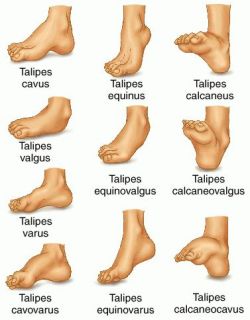
Talipes is a deformity of the foot in which one or both feet are twisted out of shape or into the wrong position. There are two main types: talipes equinovarus (club foot) and talipes calcaneovalgus.
Symptoms
In talipes equinovarus, the heel is turned inwards and the whole foot is rolled inwards with the toes pointing upwards. . If the cause is positional and the foot is of normal size, the deformity is usually mild and the foot can easily be manipulated into the normal position.
In structural talipes equinovarus, the affected foot is shorter and the calf muscles are thinner than normal. The position of the foot is fixed and can't be easily corrected.
In talipes calcaneovalgus, the foot is turned outwards with the toes pointing upwards.
Causes and risk factors
Talipes may be positional or structural. Positional talipes is caused by abnormal pressures compressing the foot while it's developing, as a result of its position in the womb. Structural talipes is a more complex condition and probably caused by a combination of factors, such as a genetic predisposition.
It may also result from a condition called oligohydramnios, where there's a shortage of amniotic fluid around the baby in the womb.
One in 1,000 babies is born with talipes. It's twice as common in boys than in girls. A genetic predisposition means it tends to run in families. There may be associated abnormalities elsewhere in the body, especially with the bones. In 50 per cent of cases, both feet are affected.
Talipes can be detected antenatally during the routine development ultrasound scan around 20 weeks.
Often, however, it's diagnosed from the appearance of the foot after a baby is born. X-rays may be needed to confirm diagnosis.
Treatment and recovery
Positional talipes may not require treatment, although exercises to help the foot regain its natural position may be recommended - a physiotherapist can show parents what to do.
Talipes calcaneovalgus is also usually positional and only occasionally needs treatment with foot exercises.
Structural talipes needs prompt treatment, while the baby's tissues are still soft, with manipulation of the foot towards the correct position and methods such as strapping or casting to hold it in place.
This may need to be carried out for several months, and may involve putting the feet in splints at night.
A growing number of specialists are now using the Ponseti method, which uses manipulation and casting, followed by boots with a splint to hold the foot in the most effective position.
In about 50 per cent of cases, this isn't effective and an operation to straighten the foot may be recommended after the age of six months.